
Style Atelier in a prestigious venue
Carine Landau | Executive Image & Presence Strategist | Paris · Frankfurt · Cannes
Could a door left unopened cost you a client relationship?
A door nobody holds. A visitor waiting without a greeting. An employee pointing down a corridor instead of accompanying a guest. A departure without a thank-you. These details cost almost nothing, yet immediately influence how a business is perceived.
Companies invest in premises, expertise, technology and brand communication. When the human experience fails to live up to that investment, part of the brand promise is lost. That is why five-star service principles deserve a place well beyond hospitality.
Upgrading service through people is the thread running through this article. Service excellence is not created by products or premises alone, but by the quality of every human interaction, with your clients and within your teams.
The question is not “Are we a luxury business?” It is “What quality of attention do our clients, partners and teams actually experience?”
1. What “five-star” really means
Hotel classifications and independent rating systems are not all the same. The French hotel classification and Forbes Travel Guide ratings, for example, are distinct frameworks. Here, the focus is on service principles inspired by outstanding hospitality and adapted to other industries.
Forbes Travel Guide states that its anonymous inspectors assess properties against up to 900 objective standards. The assessment spans the entire guest journey, from reservation to departure, with particular emphasis on service quality, courtesy, efficiency and personal attention [1-3].
The lesson for every business is straightforward: excellence is not an abstract claim. It is a series of observable, repeatable behaviours adapted to the person and the situation.
2. Even prestigious organisations can overlook the essentials
The conclusion is clear: even in popular television series broadcast by major media outlets, the gestures that define a warm welcome deserve greater attention: a door not held open, a lack of guidance or a simple thank-you.
Far from passing judgment, these observations show that such gestures have yet to become second nature to everyone. There is still progress to be made.
The point is not to blame anyone for an omission. It is to ask whether the expected behaviours have been defined, explained and practised. Service quality cannot depend solely on individual goodwill. It must be taught, practised and assessed.
What seems natural in a leading hotel may not be part of the daily habits of a bank, head office, hair salon, law firm or technology company. Yet all these organisations bring people into contact with people.
3. Seven five-star standards any business can adopt

01 | Acknowledge people immediately
Make eye contact, greet visitors and explain who will assist them next.
What to observe: Visitors should never feel invisible.
02 | Accompany rather than merely direct
Hold a door when appropriate, walk guests to the right place or offer accessible assistance.
What to observe: People should not be left to navigate alone.
03 | Anticipate discreetly
Prepare the meeting, check comfort needs and communicate any waiting time.
What to observe: Anticipation should be thoughtful, not intrusive.
04 | Personalise genuinely
Use names appropriately, listen to preferences and adapt explanations.
What to observe: Consistent care does not mean identical treatment.
05 | Deliver a shared service signature
Define standards for every touchpoint, including phone, email and follow-up.
What to observe: Quality should not depend on whom the client happens to meet.
06 | Handle the unexpected calmly
Acknowledge the issue, explain the next steps, give a realistic timeframe and follow through.
What to observe: A problem receives visible and responsible attention.
07 | Close the interaction with appreciation
Confirm next steps, offer sincere thanks and make departure easy.
What to observe: Care should not disappear once the transaction is complete.
These seven principles provide a practical starting point for bringing the standards of luxury hospitality into the corporate world. A tailored framework is then developed for each company, reflecting its culture, objectives and specific challenges.
These principles do not reproduce the official Forbes Travel Guide rating criteria.
4. The client journey: where experiences succeed or fail
The challenge is not to deliver one exceptional gesture a year. It is to create reliable quality across the entire journey: before the meeting, on arrival, throughout the service, when something goes wrong, at departure and afterwards.
| Touchpoint | Key question | Expected behaviour |
|---|---|---|
| Before contact | Does the client know what to expect? | Clear confirmation, useful information, named contact. |
| On arrival | Do they feel recognised? | Visible greeting and appropriate guidance. |
| During the service | Do they feel heard and understood? | Open questions, active listening, relevant advice. |
| When something goes wrong | Do they know who will act and when? | Named owner, realistic timing and follow-up. |
| At departure | Is the relationship acknowledged? | Personal thanks and clear next steps. |
| After the visit | Does the attention continue? | Relevant, non-intrusive follow-up. |
5. Practical applications across industries
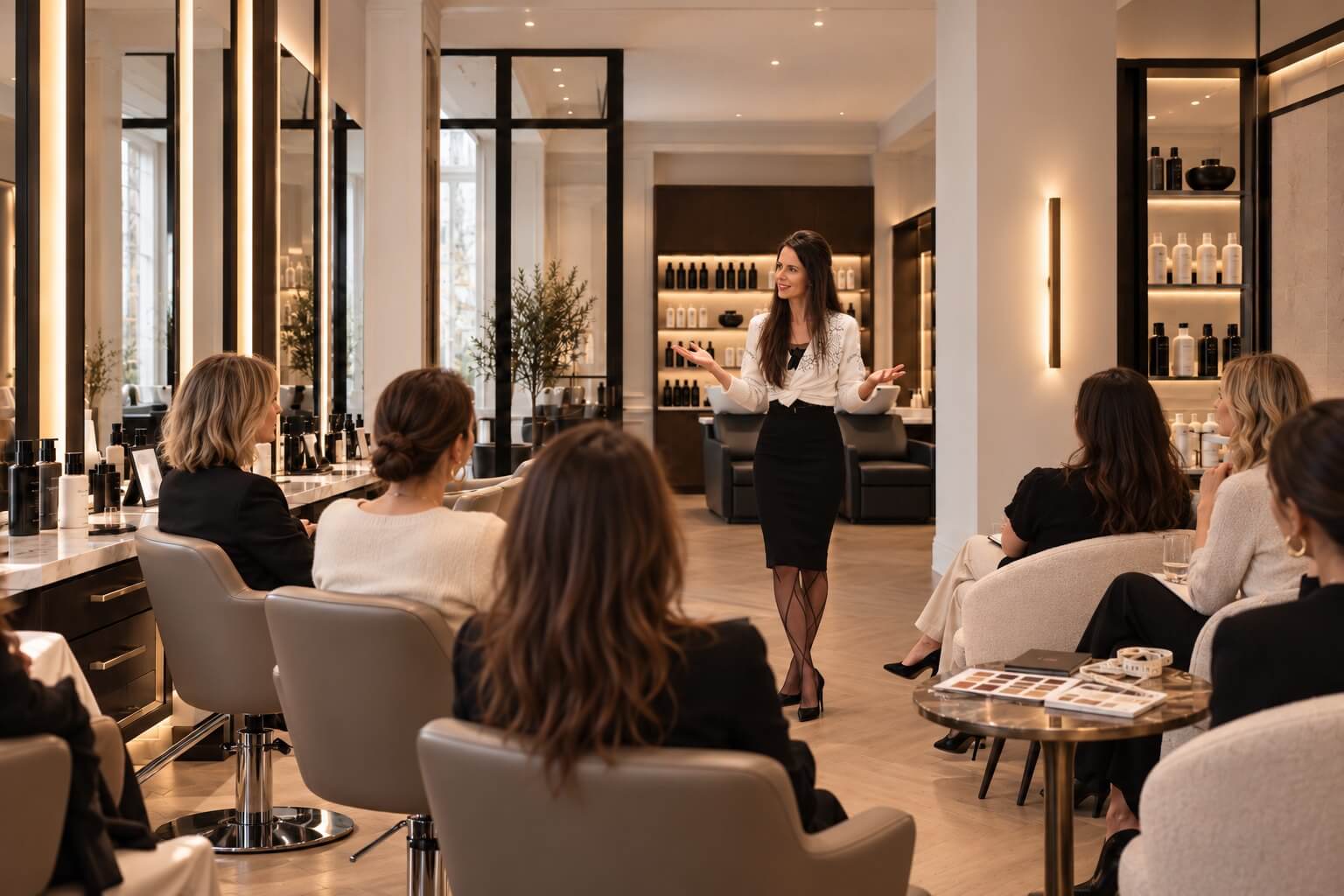
Hair salons: turning a service into a relationship
Technical excellence in a haircut or colour treatment is essential. But so are the welcome, initial consultation, advice without sales pressure and thoughtful follow-up. Salons can introduce consistent welcome rituals, structured consultations and shared service standards.
Private banking and financial services
Before any investment discussion, clients notice discretion, punctuality, clarity and whether promises are kept. Premium service is also about confidentiality, meeting preparation and smooth handovers between contacts.
Professional services and B2B businesses
Expertise alone does not guarantee a strong relationship. A clearly run meeting, accessible explanations, reliable commitments and thoughtful follow-up build confidence when the stakes are high.
Industry, technology and institutions
Site visits, product demonstrations, supplier meetings, onboarding and support calls all reveal company culture. Service standards matter in internal relationships, too.
6. From luxury hospitality to jewellery and private banking: three worlds, one shared commitment to human excellence
My projects and professional experiences across these three demanding industries have shaped my approach to executive presence and the client experience. While the contexts and formats of my work differ, they are united by one conviction: excellence is not defined solely by the quality of a product or service, but also by the quality of human relationships.
Luxury hospitality – Sofitel Frankfurt Opera: welcoming, connecting and creating experiences
It was notably at Sofitel Frankfurt Opera that I developed my signature Style Atelier, designed as immersive experiences rather than traditional conferences.
The welcome, the setting, the rhythm, the interactions between guests and the attention given to every detail, right through to their departure, all contribute to the perception of value.
Jewellery: the power of emotion
In the world of fine jewellery, a client relationship can be part of a deeply meaningful moment. The encounters and experiences I have had in this environment illustrate the importance of creating conversations that go beyond the object itself, placing the individual, their story and their expectations at the centre.
Private banking: expertise, discretion and trust
Private banking highlights another essential dimension: outstanding technical expertise must also be reflected in clear communication, the quality of advice and relationships that inspire trust.
Expertise becomes more powerful when it is embodied.
Three worlds, one shared lesson: places and products set the stage, but excellence is built above all through human relationships.
7. How to introduce service standards in 30 days

Each programme is tailored following an initial assessment to address your company’s specific challenges and ensure practical, measurable implementation focused on results.
Here is an example of a four-week implementation plan, without complex programmes or unnecessary procedures.
| Timing | Action | Practical deliverable |
|---|---|---|
| Week 1 | Observe 5 to 10 real interactions: telephone, welcome, appointment and departure. | Map the moments that matter and identify friction. |
| Week 2 | Choose five non-negotiable standards tailored to the brand. | One-page service charter and suggested language. |
| Week 3 | Train teams using real situations. | 15-minute practice sessions, role-play and feedback. |
| Week 4 | Review results and refine behaviours together. | Initial dashboard and monthly review plan. |
8. Measuring quality and results without reducing the human dimension to a score
Relational excellence cannot simply be declared: it must be developed, practised and measured.
Each programme begins with an initial assessment and the joint definition of concrete objectives and key performance indicators (KPIs), tailored to your company, your teams and your specific challenges.
Every stage is monitored through precise KPIs, agreed upon together from the outset. This approach makes it possible to assess progress, adjust actions and measure results without reducing the richness of human interactions to a single number.
Depending on the objectives agreed upon, these indicators may include:
- Service standards: quality of the welcome, client guidance and adherence to jointly defined standards.
- Quality of follow-up: fulfilment of commitments, respect for agreed deadlines and delivery on promises made to clients.
- Voice of the client: satisfaction, feedback, perception of relational quality and recurring sources of dissatisfaction.
- Client loyalty and referrals: repeat purchases, returning clients, recommendations and the development of lasting relationships.
- Team engagement: adoption of standards, behavioural improvements, practical exercises and initiatives for continuous improvement.
Results are assessed against an established baseline, then compared throughout the programme and during follow-up.
The objective is not to multiply indicators, but to select those that truly matter to your company and translate improvements in human interactions into concrete, measurable results.
The impact on commercial performance and client loyalty naturally depends on the context, business model and quality of implementation.
9. Performance with elegance™: turning interactions into value
Service excellence is not simply a matter of protocol. It requires consistency between a company’s identity, the behaviour of its teams and the relationships it seeks to build with its clients.
The Performance with elegance™ method brings together four complementary dimensions:
- Elegance: align codes, image and behaviours with the brand promise.
- Presence: develop posture, listening skills, voice and self-control in every interaction.
- Alliance: create the conditions for lasting relationships built on respect and trust.
- Influence: communicate value clearly, facilitate decisions and build loyalty without pressure.
Through Guest Experiences, Team Experiences and Executive Advisory, Carine Landau personally supports leaders and teams in enhancing the client journey, developing professional presence and creating signature experiences.
Her work complements industry-specific expertise by strengthening the human dimension that shapes how this expertise is perceived.
Conclusion: Is your company five-star in every interaction?
You don’t need a luxury hotel, a premium product or an unlimited budget to hold a door open, express genuine gratitude, anticipate someone’s needs or keep a promise. What you do need is a shared commitment to excellence, thoughtful gestures, well-trained teams and consistent follow-up.
Excellence is not defined by the stars displayed, but by the standards lived every day.
As this famous quote, often attributed to Maya Angelou, reminds us:
“People will forget what you said, people will forget what you did, but people will never forget how you made them feel.”
Starting tomorrow, choose just one moment in your client journey: the arrival, the first phone call or the departure. Observe it. Define what should happen. Train your team. Then measure what changes.
The greatest transformations often begin with a first step, sometimes with the smallest detail.
Your next step: Would you like to assess your client journey, strengthen your teams’ interpersonal skills or create a signature Guest Experience?
Let’s build a standard of service that matches your ambitions.
Carine Landau | Executive Image & Presence Strategist | Paris · Frankfurt · Cannes
Guest Experiences · Team Experiences · Executive Advisory · Keynotes
Frequently asked questions
What is a five-star service standard?
A clear, observable expectation about service, inspired by outstanding hospitality, such as the welcome, personal attention, advice or follow-up.
Are five-star standards relevant only to luxury hotels?
No. They can be adapted to salons, banks, law firms, manufacturers, service companies and internal teams.
Where can a business start with a limited budget?
Map the client journey, choose five priority behaviours, train staff and collect feedback.
How should teams be trained in premium service?
Through observation, practical examples, role-play and regular feedback, not simply a policy document.
How can business impact be measured?
Track both execution of the standards and client or business outcomes against a starting point.
Sources
[1] Forbes Travel Guide, Media Center / How Star Ratings Are Determined (accessed 10 November 2026). forbestravelguide.com/media-center
[2] Forbes Travel Guide, About / How we inspect (accessed 10 November 2026). forbestravelguide.com/about
[3] Forbes Travel Guide Stories, What Makes A Forbes Travel Guide Five Star? (10 February 2026). stories.forbestravelguide.com


